Healthcare & Life Sciences AI Solutions.
Healthcare, Pharma & Biotech AI
BharatBits AI develops intelligent, cloud-native AI solutions for hospitals, healthcare providers, insurance payers, pharmaceutical companies, biotechnology organizations, and life sciences enterprises. Our solutions help automate complex workflows, streamline documentation, improve operational efficiency, and support data-driven decisions.
Built on Google Cloud Platform (GCP), our AI solutions combine Generative AI, intelligent agents, clinical document processing, multimodal analysis, predictive analytics, and secure data integration. Using technologies such as Vertex AI, Gemini, Cloud Healthcare API, Document AI, BigQuery, Cloud Run, Pub/Sub, and Dataflow, we help organizations modernize healthcare and life sciences operations.
Our Healthcare, Pharma & Biotech AI Solutions
• Autonomous Prior Authorization Agent — Extracts clinical information, retrieves payer policy criteria, identifies missing documentation, and prepares authorization recommendations for appropriate medical review.
• Ambient Clinical Documentation Agent — Converts clinician-patient conversations into structured clinical notes, including SOAP documentation, and suggests diagnosis and billing codes for clinician review.
• Multimodal Diagnostic Triage Agent — Analyzes medical imaging alongside relevant patient information to flag potential urgent findings and help clinical teams prioritize cases.
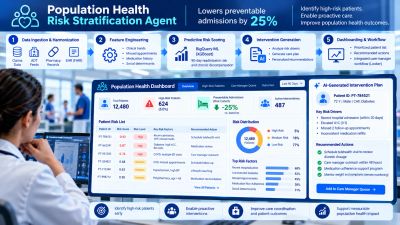
• Population Health Risk Stratification Agent — Uses patient history, clinical indicators, and healthcare utilization data to identify higher-risk populations and support targeted preventive care.
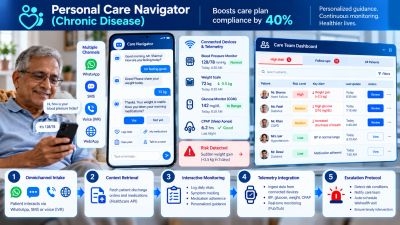
• Personal Care Navigator — Chronic Disease Management — Supports patients with care-plan reminders, symptom tracking, follow-up communication, and escalation of concerning information to healthcare teams.
• Clinical Trial Patient Matching Agent — Compares trial eligibility criteria with patient records to identify potential candidates and generate evidence-linked matching summaries for research teams.
• Regulatory Submission (eCTD) Agent — Helps organize regulatory documents, extract source evidence, draft submission content, and link generated claims to supporting material for verification.
• Pharmacovigilance (PV) Signal Detection Agent — Processes adverse event reports, structures drug-safety information, supports standardized safety coding, and helps identify potential safety signals for expert investigation.
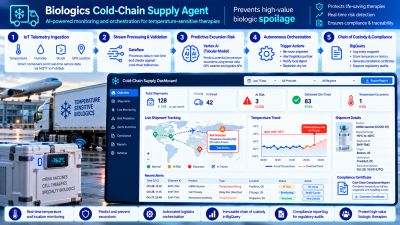
• Biologics Cold-Chain Supply Agent — Processes temperature and shipment telemetry to detect potential cold-chain excursions, generate alerts, and support timely interventions for temperature-sensitive medicines and biologics.
Enterprise-Ready GCP Architecture
Our solutions are designed around secure cloud infrastructure, scalable data processing, controlled access, and integration with existing healthcare systems. Depending on the use case, the architecture can incorporate Vertex AI and Gemini for AI capabilities; Cloud Healthcare API for FHIR-based interoperability; Document AI and Cloud Storage for document processing; Big Query, Pub/Sub, and Dataflow for data engineering and analytics; and Cloud Run for application deployment and APIs.
Business Value
• Reduce repetitive administrative work and document-processing effort.
• Improve clinical workflow efficiency and patient-care coordination.
• Support clinical trial screening and regulatory documentation workflows.
• Strengthen drug-safety monitoring and adverse event review.
• Improve cold-chain visibility and exception management.
• Enable scalable, secure, data-driven healthcare and life sciences operations.
Responsible AI: AI-generated insights support qualified professionals rather than replace their judgment. Clinical findings, patient-care actions, regulatory submissions, and drug-safety assessments remain subject to appropriate human review, validation, and applicable regulatory requirements.

Autonomous Prior Authorization Agent
Business Objective: Accelerate prior authorization processing by automating clinical document review, payer-policy matching, and authorization workflow preparation.
Target Outcome: Designed to reduce manual review time by up to 90% in eligible workflows; actual results depend on case complexity, data quality, payer rules, and validation.
SYSTEM ARCHITECTURE
A multi-agent orchestration architecture that processes prior authorization requests, extracts relevant clinical evidence, retrieves applicable payer policies, and evaluates requests against configured criteria. Straightforward cases can be prepared for streamlined processing, while ambiguous or incomplete cases are routed to qualified clinical reviewers for a final decision.
STEP-BY-STEP PROCESS FLOW
1. Request Ingestion & Document Processing
Authorization requests enter through supported HL7 v2 ADT/ORM messages, API integrations, or uploaded clinical documents stored in Google Cloud Storage. Document AI processes supported documents to extract patient demographics, provider details, and relevant clinical information.
2. Clinical Data Extraction
A clinical language-model agent analyzes physician notes and supporting records to identify diagnoses, requested procedures, relevant medical history, and documented conservative treatments. Extracted information is structured for downstream evaluation, with source references retained where supported.
3. Payer Guideline Retrieval (RAG)
A retrieval-augmented generation (RAG) component searches an approved knowledge repository containing applicable payer medical policies and authorization criteria. Vertex AI Search or Vertex AI Vector Search can support retrieval, depending on the selected implementation.
4. Criteria Evaluation & Gap Analysis
A decision-support agent compares the extracted clinical evidence with the retrieved policy criteria. It identifies satisfied requirements, missing documentation, and conflicting information, producing a structured assessment for review rather than relying solely on unrestricted model judgment.
5. Workflow Orchestration & System Writeback
Requests with complete evidence are prepared for the configured authorization workflow. Incomplete or ambiguous cases are routed to an appropriate clinical review queue with a gap-analysis summary. Where supported and authorized, the system can integrate with payer or provider platforms to transmit status updates or prepare standardized transaction data.
GCP STACK COMPONENTS
- Document AI: Clinical document processing and information extraction.
- Cloud Healthcare API: Healthcare data interoperability and supported FHIR/HL7 workflows.
- Vertex AI: Model inference, orchestration, and AI application development.
- Vertex AI Search / Vector Search: Retrieval of approved payer policies and clinical criteria.
- Cloud Storage: Secure storage for incoming documents and supporting files.
- Cloud Run: API services and backend processing.
- Pub/Sub and Cloud Tasks: Asynchronous processing and workflow coordination, where required.
- BigQuery: Operational analytics, processing metrics, and audit reporting, subject to data-governance requirements.
- Identity and Access Management (IAM): Role-based access and service permissions.
GOVERNANCE, SAFETY & HUMAN OVERSIGHT
- Apply appropriate access controls and protection for sensitive health information.
- Maintain traceability between clinical evidence, retrieved policy criteria, and generated assessments.
- Require qualified human review for ambiguous cases and decisions that require clinical judgment.
- Validate payer-specific rules, transaction formats, and interoperability before production use.
- Treat automated approval or denial as a separately governed capability requiring explicit authorization, compliance review, and end-to-end testing.
BUSINESS VALUE
- Reduce repetitive manual document review.
- Accelerate identification of missing clinical evidence.
- Improve consistency in applying payer-specific criteria.
- Help reviewers prioritize complex or incomplete requests.
- Improve visibility into authorization workflow status and bottlenecks.
- Support scalable processing while retaining appropriate clinical oversight.
Multimodal Diagnostic Triage Agent
Business Objective: Help radiology departments identify potentially critical imaging findings sooner by combining AI-assisted image analysis with relevant patient-record context and prioritizing studies for radiologist review.
Target Outcome: Support faster identification and escalation of potentially urgent scans. Actual performance depends on the imaging modality, validated models, clinical workflow, and hospital integration.
SYSTEM ARCHITECTURE
A multimodal clinical decision-support architecture that processes incoming radiology studies, analyzes image data for configured findings, and correlates results with relevant electronic health record (EHR) information. The system generates prioritization signals and routes flagged studies into the appropriate clinical workflow, while qualified radiologists retain responsibility for interpretation and diagnosis.
STEP-BY-STEP PROCESS FLOW
1. DICOM Ingestion & Study Registration
The hospital's Picture Archiving and Communication System (PACS) sends imaging studies through a supported DICOM interface to the Cloud Healthcare API DICOM store. Study metadata, identifiers, and associated patient references are registered for processing.
2. Event Trigger & Workflow Orchestration
A study-arrival event initiates the configured processing workflow through Pub/Sub and Cloud Run or Cloud Functions. The orchestration layer validates the incoming study, tracks processing status, and routes eligible imaging data to the appropriate analysis component.
3. Multimodal Image Analysis
A validated medical-imaging model analyzes supported image data for configured findings, such as suspected intracranial hemorrhage, midline shift, or pulmonary abnormalities. Model outputs may include candidate regions of interest, confidence scores, and supporting image references, depending on the model's capabilities.
4. Clinical Context Correlation
A contextual processing component retrieves relevant information from authorized EHR records through supported FHIR interfaces, where available. Relevant history, prior imaging references, laboratory results, and documented procedures can be presented alongside the imaging findings to support clinical review. Patient context should not independently override imaging evidence or substitute for clinical interpretation.
5. Triage Prioritization & Clinical Alerting
A configured triage policy evaluates the model output and routes potentially urgent studies for prioritized review. Where supported by the hospital's integration, the system can send a validated workflow message or update to the Radiology Information System (RIS), including study identifiers, priority information, and references to candidate findings. A qualified radiologist reviews the scan and determines the clinical interpretation.
GCP STACK COMPONENTS
- Cloud Healthcare API (DICOM): Secure storage and management of supported medical imaging studies.
- Cloud Healthcare API (FHIR): Access to authorized patient context and interoperable clinical records.
- Vertex AI: Deployment and orchestration of supported AI inference components.
- Validated Medical Imaging Models: Image analysis for specific findings and modalities; model selection and validation are required.
- Pub/Sub: Event-driven notifications and asynchronous workflow coordination.
- Cloud Run / Cloud Functions: Backend processing, integration services, and routing logic.
- Vertex AI Pipelines: Optional orchestration for supported model-processing and evaluation pipelines.
- Cloud Logging & Monitoring: Processing observability, error tracking, and operational monitoring.
- IAM & Audit Controls: Access restrictions and traceability for sensitive clinical data.
GOVERNANCE, SAFETY & HUMAN OVERSIGHT
- Validate model performance for the intended imaging modality, population, and clinical use.
- Route urgent findings according to hospital-approved triage policies.
- Keep AI-generated findings distinct from confirmed radiologist interpretations.
- Maintain traceability between the imaging study, model output, and resulting workflow action.
- Apply appropriate access controls, audit logging, and health-data protection requirements.
- Test RIS/PACS interoperability and escalation behavior before production deployment.
BUSINESS VALUE
- Help identify potentially urgent studies earlier in the radiology workflow.
- Support prioritization of imaging studies for clinical review.
- Reduce manual effort involved in routing and managing flagged studies.
- Present relevant patient context alongside AI-generated imaging observations.
- Improve visibility into study-processing status and triage queues.
- Support scalable radiology workflows while keeping clinical decisions under qualified professional oversight.

Population Health Risk Stratification Agent
Business Objective: Help healthcare organizations identify patients who may be at elevated risk of hospital readmission or chronic disease deterioration by combining clinical, claims, pharmacy, and care-utilization data to support proactive care management.
Target Outcome: Aims to support earlier intervention and reduce potentially preventable admissions. A 25% reduction is a target that must be validated through measured clinical and operational outcomes; actual results depend on the patient population, intervention effectiveness, and care delivery workflows.
SYSTEM ARCHITECTURE
A population-level analytics and AI architecture that consolidates patient information, engineers' predictive features, calculates risk scores, and generates prioritized care-management recommendations. Predictive models identify patients who may need additional attention, while a generative AI component summarizes contributing risk factors and drafts suggested interventions for review by authorized care teams.
STEP-BY-STEP PROCESS FLOW
1. Data Ingestion & Harmonization
Clinical data, claims, admission-discharge-transfer (ADT) events, pharmacy records, and other approved sources are ingested through configured batch or streaming pipelines. Healthcare Data Engine (HDE), where available and appropriate, or supported healthcare interoperability services can map data into a unified FHIR-based representation.
2. Feature Engineering & Data Preparation
Dataflow pipelines and BigQuery transformations prepare relevant features, such as recent admissions, chronic condition history, available laboratory trends, missed appointments, medication-related indicators, and approved social determinants of health. Data-quality checks address missing values, inconsistent identifiers, and data freshness before scoring.
3. Predictive Risk Scoring
A scheduled BigQuery ML workflow or a deployed model evaluates eligible patient records to estimate a defined outcome, such as 90-day readmission risk or chronic disease deterioration. Model outputs are used to rank patients for further assessment, with thresholds calibrated and evaluated against the intended population.
4. Risk Driver Analysis & Intervention Planning
For patients prioritized by the risk model, a generative AI component summarizes the available risk indicators and drafts potential care-management actions, such as scheduling follow-up, reviewing medication adherence, or arranging a telehealth appointment. Recommendations are grounded in available records and routed to qualified care staff for review before action.
5. Care Manager Dashboard & Workflow Integration
Risk scores, contributing factors, data freshness indicators, and suggested interventions are presented through a Looker dashboard or configured care-management interface. Care managers can review prioritized patient lists, document follow-up actions, and track intervention status through supported workflows.
GCP STACK COMPONENTS
- Healthcare Data Engine (HDE) / Healthcare Interoperability Services: Harmonization of supported healthcare data sources, where available.
- Cloud Healthcare API (FHIR): FHIR-based exchange and management of supported clinical data.
- BigQuery: Centralized analytics, patient-level feature tables, and reporting datasets.
- BigQuery ML: Predictive modeling and scheduled risk scoring where the selected model is supported.
- Dataflow: Batch and streaming data transformation and feature preparation.
- Vertex AI: Optional model serving and generative AI orchestration for risk summaries and intervention drafts.
- Looker: Population-level dashboards and care-manager reporting.
- Cloud Scheduler / Workflows: Scheduled scoring and orchestration, where required.
- IAM, Cloud Logging & Audit Controls: Access management, monitoring, and traceability for sensitive health data.
GOVERNANCE, SAFETY & HUMAN OVERSIGHT
- Validate model performance, calibration, and fairness across relevant patient groups.
- Define the prediction target and time horizon clearly, and monitor model drift.
- Use only authorized, relevant patient data and apply appropriate access controls.
- Present risk scores as decision-support signals, not definitive predictions of an individual patient's outcome.
- Require qualified clinical review before interventions, medication changes, or care-plan decisions.
- Monitor intervention completion and clinical outcomes to evaluate whether the program improves care.
BUSINESS VALUE
- Identify patients who may benefit from earlier care-team attention.
- Support proactive outreach and follow-up planning.
- Help care managers prioritize limited resources using consistent risk indicators.
- Improve visibility into population-level trends and care gaps.
- Reduce manual effort involved in assembling patient risk summaries.
- Support measurable evaluation of care-management interventions and outcomes.
Personal Care Navigator (Chronic Disease)
Business Objective: Support patients living with chronic conditions through personalized care-plan guidance, post-discharge follow-up, symptom monitoring, and timely escalation of concerns to their care team.
Target Outcome: Aims to improve care-plan adherence by up to 40% through personalized engagement and proactive follow-up. This is a target that requires validation; actual outcomes depend on patient engagement, care-team workflows, accessibility, and the effectiveness of interventions.
SYSTEM ARCHITECTURE
An omnichannel conversational AI architecture that connects patients with configured care-management workflows through supported messaging and voice channels. A conversational agent retrieves authorized care-plan information, collects patient-reported symptoms and measurements, and identifies responses that may require follow-up. Where supported, device data can be incorporated to improve monitoring. Escalation rules route concerning information to designated clinical staff, with clinical decisions remaining under qualified professional oversight.
STEP-BY-STEP PROCESS FLOW
1. Omnichannel Patient Intake
Patients interact through supported channels such as SMS, WhatsApp, or voice-based interactive voice response (IVR). Dialog flow CX interprets patient messages, identifies intent, and guides the conversation through configured care-management tasks. Channel availability depends on the selected integrations.
2. Patient Context Retrieval
A context component retrieves authorized patient information through supported Cloud Healthcare API FHIR interfaces, including relevant discharge instructions, care-plan details, and medication lists. The agent uses this information to provide context-aware guidance within approved clinical boundaries.
3. Interactive Monitoring & Check-ins
The conversational agent conducts scheduled check-ins and records patient-reported symptoms, medication-related concerns, and measurements such as blood pressure or weight. Follow-up questions can be tailored to the patient's documented care plan. The system distinguishes patient-reported information from measurements obtained through connected devices.
4. Connected Device & Telemetry Integration
Where supported, data from connected devices—such as blood pressure monitors, weight scales, continuous glucose monitors, or CPAP systems—can be ingested through configured device integrations and Pub/Sub-based pipelines. Data is validated, associated with the appropriate patient, and evaluated against approved thresholds before being used in monitoring workflows.
5. Risk Detection & Escalation
A configured escalation component evaluates concerning symptoms, reported measurements, and eligible device readings against predefined rules. When a trigger condition is met, it routes an alert to the designated clinical team through the configured notification or care-management system. It may also prepare a follow-up appointment request or telehealth invitation where supported. Urgent situations must follow the organization's approved escalation and emergency-response protocols.
GCP STACK COMPONENTS
- Dialog flow CX: Conversational workflow management and intent recognition.
- Vertex AI / Gemini: Context-aware conversational assistance and care-plan information summarization, subject to approved use and validation.
- Cloud Healthcare API (FHIR): Access to authorized patient and care-plan information.
- Pub/Sub: Event-driven processing for supported device telemetry and monitoring events.
- Cloud Run / Cloud Functions: Backend integration, processing, and escalation services.
- Cloud Storage: Storage for supported documents and other configured care-management resources.
- Cloud Logging & Monitoring: Operational observability, error tracking, and workflow monitoring.
- IAM & Audit Controls: Access permissions and traceability for sensitive health information.
GOVERNANCE, SAFETY & HUMAN OVERSIGHT
- Apply patient consent, identity verification, and appropriate access controls across communication channels.
- Restrict responses to approved care-plan information and clearly defined conversational boundaries.
- Validate device data, patient identity matching, units, timestamps, and measurement quality.
- Route concerning symptoms or threshold breaches according to clinically approved escalation protocols.
- Do not independently diagnose conditions, change medication dosages, or replace clinician judgment.
- Provide appropriate fallback and emergency guidance when patients report potentially urgent symptoms.
- Monitor engagement, escalation response times, data quality, and care-plan adherence.
BUSINESS VALUE
- Encourage more consistent patient engagement between clinical visits.
- Reduce manual effort associated with routine follow-up and check-in workflows.
- Help care teams identify reported concerns that may require timely attention.
- Support continuity of care following hospital discharge.
- Improve visibility into patient-reported symptoms and available home-monitoring data.
- Enable more scalable chronic disease care-management workflows.
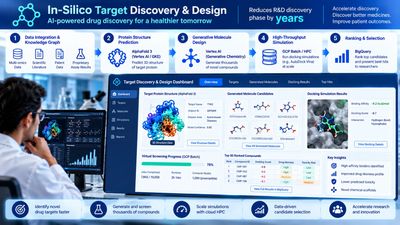
In-Silico Target Discovery & Design
Business Objective: Accelerate early-stage drug discovery by combining biological data analysis, protein-structure modeling, generative chemistry, and computational screening to help researchers identify promising therapeutic targets and candidate molecules.
Target Outcome: Designed to shorten parts of the early discovery workflow by prioritizing research hypotheses and candidate compounds more efficiently. Any claim of reducing discovery timelines by years must be validated against a defined baseline and measured research outcomes.
SYSTEM ARCHITECTURE
A computational drug-discovery pipeline that integrates multi-omics data, scientific literature, protein-structure prediction, generative molecular design, and high-throughput virtual screening. The system ranks candidate targets and molecules using configurable scientific criteria, enabling computational chemists and biologists to focus on promising candidates for further evaluation.
STEP-BY-STEP PROCESS FLOW
1. Scientific Data Integration & Knowledge Graph Construction
Relevant biological datasets, public scientific literature, patent information, and available assay results are ingested from approved sources. Big Query supports structured data storage and analysis, while a knowledge graph or graph-based retrieval layer can connect genes, proteins, pathways, diseases, compounds, and experimental evidence.
2. Target Selection & Protein Structure Modeling
Researchers select a disease-associated protein or pathway for investigation. Protein structures are retrieved from validated scientific resources or predicted using an appropriate structure-prediction model, such as AlphaFold 3 where access and usage conditions permit. Structure quality, biological context, and uncertainty are assessed before downstream screening.
3. Generative Molecule Design
A molecular-design component proposes candidate compounds using suitable generative models and chemical representations such as SMILES. Candidate generation can be guided by defined objectives, including predicted binding affinity, chemical validity, synthesizability, selectivity, and toxicity-related risk indicators. Generated molecules remain computational hypotheses until experimentally evaluated.
4. High-Throughput Virtual Screening
Google Cloud Batch or other suitable high-performance computing resources can execute parallel molecular docking and related simulations. Tools such as AutoDock Vina may estimate plausible binding poses and scoring functions for candidate molecules against the selected protein structure. Results are recorded alongside model settings and relevant run metadata.
5. Candidate Ranking & Researcher Review
Screening results are consolidated in Big Query or an appropriate research data store. A ranking component prioritizes candidates using configured criteria, potentially combining docking scores, chemical properties, novelty checks, and predicted safety indicators. Researchers review the evidence and select candidates for follow-up simulations, synthesis, and laboratory validation.
GCP STACK COMPONENTS
- Big Query: Storage, integration, and analysis of structured biological and screening data.
- Vertex AI: Hosting or orchestrating supported custom models and molecular-design workflows.
- Google Cloud Batch: Parallel execution of computational screening and simulation jobs.
- Google Kubernetes Engine (GKE): Optional orchestration for containerized research workloads where needed.
- Cloud Storage: Storage for molecular structures, protein files, simulation outputs, and research artifacts.
- AlphaFold 3 / Approved Structure-Prediction Resources: Protein-structure modeling, subject to access, deployment, and usage conditions.
- AutoDock Vina / Molecular Docking Tools: Virtual screening and approximate ligand-binding pose evaluation.
- Cloud Logging & Monitoring: Job status, failures, resource utilization, and operational monitoring.
- IAM & Research Data Governance: Controlled access to datasets, model artifacts, and proprietary research information.
SCIENTIFIC VALIDATION & GOVERNANCE
- Track the provenance, licensing, and quality of biological datasets and scientific references.
- Validate protein structures, target relevance, and molecular representations before screening.
- Treat docking scores and predicted binding affinity as computational estimates, not proof of biological activity.
- Evaluate candidate novelty, chemical feasibility, selectivity, and predicted toxicity using suitable validated methods.
- Preserve reproducibility through versioned datasets, model configurations, and simulation parameters.
- Require expert review and experimental validation before making development or safety decisions.
BUSINESS VALUE
- Reduce manual effort in early-stage target and compound prioritization.
- Screen larger candidate sets through parallel computational workflows.
- Integrate biological evidence and molecular analysis into a more consistent research process.
- Help researchers prioritize compounds for further computational or laboratory investigation.
- Improve traceability of candidate selection and screening results.
- Support scalable computational research using cloud-based infrastructure.
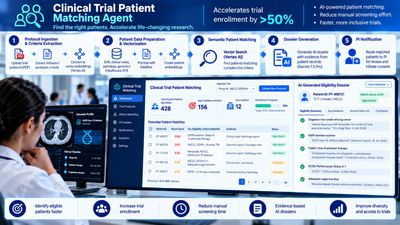
Clinical Trial Patient Matching Agent
Business Objective: Help pharmaceutical sponsors, research organizations, and clinical trial sites identify potentially eligible participants by matching clinical trial eligibility criteria against relevant patient records, reducing manual screening effort and supporting faster recruitment workflows.
Target Outcome: Aims to accelerate trial enrollment by more than 50% through AI-assisted patient discovery and screening. This target requires validation against a defined baseline; actual results depend on trial complexity, data availability, site workflows, and participant consent.
SYSTEM ARCHITECTURE
A semantic-search and clinical data-processing architecture that converts complex trial protocols into structured eligibility criteria, indexes authorized patient information and identifies records that may warrant further screening. A generative AI component prepares evidence-linked candidate summaries so research teams can efficiently review potential matches. AI-generated matches support recruitment decisions but do not establish final eligibility.
STEP-BY-STEP PROCESS FLOW
1. Trial Protocol Ingestion & Criteria Extraction
A pharmaceutical sponsor or research team uploads a supported clinical trial protocol. A document-processing agent extracts inclusion and exclusion criteria, including disease characteristics, biomarkers, prior treatments, laboratory thresholds, and other eligibility requirements. The criteria are structured for downstream matching and reviewed where interpretation is ambiguous.
2. Patient Data Preparation & Vectorization
Authorized patient records—such as clinical notes, pathology reports, diagnosis histories, and available genomic results—are processed through configured data pipelines. Dataflow can support transformation and preparation, while Vertex AI embedding models can convert suitable text into vector representations for semantic retrieval. Sensitive data is handled under the site's approved privacy and access controls.
3. Semantic Patient Matching
The matching service uses Vertex AI Vector Search or an equivalent retrieval component to identify patient records that appear relevant to the trial criteria. Structured filters and explicit eligibility checks can supplement semantic search to account for critical conditions, numerical thresholds, biomarkers, and exclusion criteria. Results are ranked for research-team review rather than treated as confirmed matches.
4. Evidence-Based Candidate Dossier Generation
For each potential match, a generative AI component prepares a concise screening summary that maps available evidence to individual trial criteria. Where supported, the dossier includes source references or excerpts from the patient record, missing information, possible exclusion factors, and items requiring verification. The system distinguishes documented facts from inferred or unavailable information.
5. Researcher Review & Site Notification
Potential candidates are routed to authorized clinical research staff or the Principal Investigator (PI) through the configured workflow. The research team verifies eligibility against the complete protocol, follows applicable privacy and recruitment procedures, and determines whether to approach the patient. Informed consent and any required screening assessments must occur before enrollment.
GCP STACK COMPONENTS
- Cloud Healthcare API (FHIR): Access and exchange of supported clinical records through authorized healthcare interfaces.
- Vertex AI: Embedding generation, model inference, and AI workflow components.
- Vertex AI Vector Search: Semantic retrieval of relevant patient records and trial criteria.
- Dataflow: Data preparation, transformation, and scalable pipeline processing.
- Cloud Storage: Storage of supported trial protocols and document-processing artifacts.
- Cloud Run: Backend APIs for protocol processing, matching, dossier generation, and workflow integration.
- Big Query: Optional structured screening metadata, operational analytics, and reporting.
- Cloud Logging & Monitoring: Processing observability, error tracking, and operational monitoring.
- IAM & Audit Controls: Role-based access, traceability, and protection of sensitive clinical information.
GOVERNANCE, SAFETY & HUMAN OVERSIGHT
- Use only authorized patient data and apply appropriate de-identification or pseudonymization where required.
- Enforce access controls and approved procedures for any re-identification or site-level outreach.
- Validate each critical inclusion and exclusion criterion using structured checks where possible.
- Maintain traceability between candidate recommendations and supporting patient-record evidence.
- Clearly flag missing, outdated, conflicting, or ambiguous clinical information.
- Require qualified research staff to confirm eligibility and oversee all recruitment and consent activities.
- Evaluate matching accuracy, false-positive rates, subgroup performance, and workflow impact before production use.
BUSINESS VALUE
- Reduce manual effort involved in reviewing lengthy clinical trial protocols and patient records.
- Help research teams discover potentially eligible participants across authorized data sources.
- Improve visibility into why a patient record was flagged for further screening.
- Support more consistent application of trial criteria across participating sites.
- Help prioritize screening resources toward candidates who warrant clinical review.
- Provide a scalable foundation for AI-assisted recruitment workflows while preserving participant privacy and consent requirements.
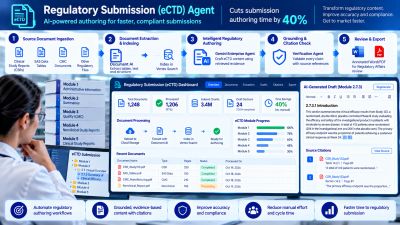
Regulatory Submission (eCTD) Agent
Business Objective: Accelerate regulatory submission preparation by using AI-assisted document processing, structured evidence retrieval, and source-grounded drafting to help pharmaceutical and biotechnology teams prepare electronic Common Technical Document (eCTD) content for regulatory review.
Target Outcome: Aims to reduce submission authoring time by up to 40% by streamlining document extraction, evidence gathering, and initial drafting. This target requires validation; actual results depend on submission complexity, source-document quality, review requirements, and regulatory standards.
SYSTEM ARCHITECTURE
An AI-assisted regulatory authoring architecture that ingests clinical, nonclinical, and Chemistry, Manufacturing, and Controls (CMC) documentation; extracts relevant evidence; and generates structured draft content aligned with selected eCTD module templates. A retrieval-augmented generation (RAG) component grounds draft statements in source material, while a verification workflow checks references and flags unsupported claims for Regulatory Affairs review.
STEP-BY-STEP PROCESS FLOW
1. Source Document Ingestion
Clinical Study Reports (CSRs), supporting tables, CMC documents, and other approved regulatory source files are uploaded to designated Google Cloud Storage buckets. Access permissions and document metadata are managed according to the organization's data-governance requirements.
2. Document Extraction & Indexing
Document AI processes supported files to extract text, tables, headings, and other relevant content. Extracted information is organized and indexed using a configured retrieval service, such as Vertex AI Search, so users and downstream agents can locate evidence across large document collections.
3. Intelligent Regulatory Authoring
A generative AI component uses approved eCTD templates, relevant source evidence, and drafting instructions to produce initial content for selected modules or sections—for example, a clinical efficacy summary. Drafts follow defined structure and terminology requirements, with source information supplied through retrieval rather than relying solely on model-generated knowledge.
4. Evidence Grounding & Verification
A verification component checks whether important statements in the generated draft are supported by the identified source documents. It validates available citations, document references, table identifiers, and section references, and flags unsupported statements, conflicting values, missing evidence, or unresolved questions. Citation verification should be based on actual source locations rather than generated hyperlinks alone.
5. Review, Export & Submission Preparation
Draft content and verification findings are exported into supported Word or PDF formats for review by Regulatory Affairs, clinical, and CMC subject-matter experts. Reviewers resolve flagged issues, approve the final wording, and complete required formatting, quality checks, and publishing steps using the organization's validated regulatory submission process.
GCP STACK COMPONENTS
- Cloud Storage: Controlled storage for source documents, extracted artifacts, and draft outputs.
- Document AI: Extraction of text, tables, and structured information from supported documents.
- Vertex AI: Generative model inference and AI workflow development.
- Vertex AI Search: Retrieval of relevant source evidence from indexed regulatory documentation.
- Cloud Run: Backend APIs and document-processing orchestration for the eCTD workflow.
- Cloud Logging & Monitoring: Processing observability, error tracking, and operational monitoring.
- IAM & Audit Controls: Access restrictions and traceability for sensitive regulatory and research documents.
GOVERNANCE, QUALITY & HUMAN OVERSIGHT
- Apply document-level access controls and protect confidential clinical, manufacturing, and regulatory information.
- Preserve source provenance and maintain traceability from drafted claims to supporting documents.
- Verify citations, table references, numerical values, and cross-document consistency.
- Flag conflicting, incomplete, or unsupported evidence instead of silently filling gaps.
- Apply approved templates, terminology standards, version controls, and review procedures.
- Require qualified Regulatory Affairs and subject-matter experts to review and approve all submission content.
- Validate the complete document workflow, including export, formatting, and quality checks, before production use.
BUSINESS VALUE
- Reduce repetitive evidence gathering and initial drafting effort.
- Help regulatory teams navigate large collections of clinical and CMC documentation.
- Improve traceability between submission statements and source evidence.
- Support more consistent use of approved eCTD templates and terminology.
- Identify missing evidence and document inconsistencies earlier in the review process.
- Enable regulatory professionals to focus more time on scientific accuracy, compliance, and final submission quality.
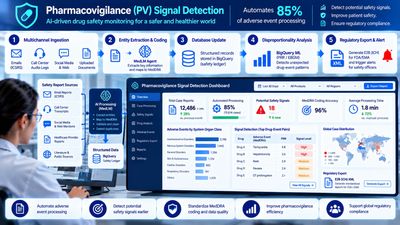
Pharmacovigilance (PV) Signal Detection Agent
Business Objective: Help pharmaceutical companies and drug-safety teams process adverse event reports more efficiently, structure safety information, and identify potential drug-event patterns that may require further investigation.
Target Outcome: Aims to automate up to 85% of routine adverse event processing tasks. This target requires validation; actual performance depends on report quality, case complexity, safety rules, and human-review requirements.
SYSTEM ARCHITECTURE
An event-driven pharmacovigilance analytics architecture that receives safety reports from configured sources, extracts and standardizes relevant information, and stores structured case data for analysis. Statistical signal-detection methods evaluate drug-event reporting patterns and surface potential safety signals for qualified safety professionals to investigate. The system supports safety monitoring and reporting workflows; it does not independently establish causality between a drug and an adverse event.
STEP-BY-STEP PROCESS FLOW
1. Multichannel Safety Report Ingestion
Individual Case Safety Reports (ICSRs) and other safety-related information enter through configured channels, such as email, supported document uploads, call-center transcripts, and approved digital sources. Pub/Sub can buffer incoming events and distribute them to downstream processing services. Data collection from social media or other public sources must follow applicable privacy, platform, and regulatory requirements.
2. Adverse Event Extraction & Standardized Coding
An AI-assisted extraction component identifies relevant information, including patient demographics where available, suspected medicinal products, adverse event descriptions, dates, reporter details, and relevant medical history. A terminology-mapping workflow proposes standardized MedDRA terms—for example, mapping “fast heartbeat” to a candidate term such as “tachycardia”—for validation against the applicable terminology version and coding rules.
3. Structured Case Storage & Validation
Extracted case information is normalized and stored in BigQuery or another appropriately configured safety data store. Validation rules check for missing fields, duplicate reports, inconsistent dates, and incomplete case information. Potential duplicates and uncertain extractions are flagged for review, and sensitive data is handled under the organization's approved security and retention policies.
4. Statistical Signal Detection
Analytics workflows evaluate drug-event reporting patterns using appropriate methods, such as the Proportional Reporting Ratio (PRR) or Empirical Bayes approaches, where suitable data and validated implementations are available. Results are assessed against configured thresholds and minimum-data requirements to identify disproportionate reporting patterns that may warrant further investigation.
5. Safety Alerts & Regulatory Reporting Support
Potential signals and case-processing exceptions are presented in a safety dashboard or routed to authorized drug-safety professionals for investigation. Where configured and validated, the solution can help prepare structured regulatory reporting data, including applicable ICH E2B message formats, for review and submission through approved reporting systems. Qualified safety personnel remain responsible for signal assessment, case validation, and regulatory decisions.
GCP STACK COMPONENTS
- Pub/Sub: Event buffering and asynchronous distribution of incoming safety reports.
- Cloud Run: Backend services for report processing, validation, terminology mapping, and workflow orchestration.
- BigQuery: Structured safety data storage, querying, and analytical processing.
- BigQuery ML / Statistical Processing: Supported analytical models and configured statistical workflows for signal detection.
- Vertex AI: Optional model inference and AI-assisted extraction or summarization.
- Cloud Storage: Storage for source documents and processing artifacts under appropriate access controls.
- Cloud Logging & Monitoring: Processing observability, error tracking, and operational monitoring.
- IAM & Audit Controls: Role-based access, traceability, and protection of sensitive safety information.
GOVERNANCE, SAFETY & HUMAN OVERSIGHT
- Validate extracted case information and standardized MedDRA coding before finalization.
- Apply duplicate detection, data-quality checks, and appropriate case-validation procedures.
- Maintain traceability from reported information to extracted fields and analytical results.
- Validate statistical methods, thresholds, and minimum-data requirements for the intended use.
- Treat detected patterns as potential safety signals, not proof of causation.
- Require qualified pharmacovigilance professionals to review cases, investigate signals, and approve regulatory submissions.
- Protect personal and sensitive health information through appropriate access controls, retention policies, and audit logging.
BUSINESS VALUE
- Reduce repetitive manual effort in adverse event report processing.
- Standardize extraction and coding across supported safety-report sources.
- Improve visibility into potential drug-event reporting patterns.
- Help prioritize cases and signals that warrant expert investigation.
- Support more consistent safety data quality and auditability.
- Enable scalable pharmacovigilance workflows while retaining qualified human oversight.
Biologics Cold-Chain Supply Agent
Business Objective: Help pharmaceutical manufacturers, healthcare distributors, and logistics providers protect temperature-sensitive biologics by monitoring shipment conditions, predicting potential cold-chain disruptions, and coordinating timely responses throughout transportation.
Target Outcome: Designed to reduce the risk of biologic spoilage, improve shipment visibility, and support cold-chain compliance. Actual results depend on sensor coverage, product-specific storage requirements, alert response times, and logistics integration.
SYSTEM ARCHITECTURE
An IoT-integrated supply-chain monitoring and orchestration architecture that combines live shipment telemetry, stream analytics, predictive risk assessment, and logistics workflow automation. Sensor readings and shipment-location data are evaluated against approved product-specific temperature and handling requirements. When an excursion or disruption risk is detected, the system alerts responsible teams and can recommend corrective actions or initiate pre-authorized logistics workflows.
STEP-BY-STEP PROCESS FLOW
1. IoT Telemetry Ingestion
Smart shipping containers and connected data loggers transmit available sensor readings, including temperature, humidity, shock, and GPS location. Devices publish data through supported MQTT gateways or IoT integrations, with Pub/Sub distributing incoming events to downstream processing services. Sensor identity, timestamps, calibration status, and shipment association are validated where supported.
2. Real-Time Stream Processing
Dataflow processes incoming telemetry and compares measurements with the approved storage and transportation limits for the specific biologic product. The workflow identifies threshold breaches, missing readings, unusual fluctuations, and prolonged periods outside acceptable conditions. Alert rules account for product-specific excursion allowances and handling procedures.
3. Predictive Cold-Chain Risk Assessment
A predictive model hosted through Vertex AI can estimate the likelihood of a potential temperature excursion using available sensor trends, shipment location, route information, weather data, and known transportation delays. Risk scores help operations teams prioritize shipments that may require intervention. Predictions are treated as risk indicators rather than guarantees of future conditions.
4. Logistics Orchestration & Corrective Action
When an excursion or elevated risk is identified, the orchestration service generates an alert and recommends an appropriate response, such as contacting the carrier, arranging an approved storage facility, inspecting refrigeration equipment, or coordinating replenishment of a qualified cooling system. Where authorized and supported by connected logistics APIs, the system can initiate predefined rerouting or intervention workflows. Safety-critical actions remain subject to approved operating procedures and responsible personnel.
5. Chain of Custody, Reporting & Delivery Verification
Shipment events—including recorded temperatures, location updates, alerts, interventions, and delivery milestones—are stored in BigQuery or another configured audit data store. The system produces a shipment history and can generate a cold-chain compliance report based on available sensor records, applicable product limits, and documented handling actions. Authorized personnel review exceptions and confirm whether the shipment meets the relevant acceptance requirements.
GCP STACK COMPONENTS
- Pub/Sub: Event ingestion and asynchronous distribution of shipment telemetry.
- Dataflow: Real-time stream processing, threshold evaluation, and telemetry transformation.
- Vertex AI: Predictive modeling and shipment risk assessment, where a validated model is configured.
- Big Query: Shipment event history, analytics, exception records, and audit reporting.
- Cloud Run: Backend APIs, alert processing, and logistics orchestration services.
- Cloud Storage: Storage for supporting shipment documents and generated reports.
- Cloud Monitoring & Logging: Operational monitoring, alert tracking, and service diagnostics.
- IAM & Audit Controls: Access restrictions, service permissions, and traceability.
GOVERNANCE, SAFETY & HUMAN OVERSIGHT
- Configure temperature limits and permitted excursion conditions for each applicable biologic product.
- Validate sensor accuracy, calibration, timestamp integrity, connectivity, and shipment-to-device mapping.
- Define alert thresholds, escalation contacts, response times, and fallback procedures for missing telemetry.
- Require approved operating procedures for rerouting, cooling-system interventions, and product disposition.
- Preserve traceable records of temperature excursions, alerts, corrective actions, and delivery events.
- Do not automatically declare a biologic safe or unusable based solely on a predictive score; qualified personnel must assess excursions against product-specific stability guidance.
- Validate the complete workflow against applicable quality systems and cold-chain requirements before production use.
BUSINESS VALUE
- Improve visibility into temperature-sensitive shipments throughout transportation.
- Identify potential cold-chain excursions earlier using sensor data and risk indicators.
- Help reduce avoidable spoilage and shipment disruption.
- Support faster coordination among carriers, depots, and logistics teams.
- Strengthen documentation of shipment conditions and corrective actions.
- Simplify preparation of cold-chain monitoring and compliance reports.
- Support more reliable transportation workflows for vaccines, biologics, and other temperature-sensitive therapies.